You have tried organizing your closets before. You pulled everything out, sorted it into neat piles, put it all back, and felt amazing for about five days. Then the shelves started collapsing again, items migrated to the wrong spots, and within two weeks it looked exactly like it did before.
The frustrating part is not the mess. It is the feeling that you are doing something wrong. That home organization should not be this hard. You see those perfectly curated closets on Pinterest and wonder what secret everyone else knows that you do not.
Here is the truth: those closets stay organized because they have a system, not because their owners have more discipline. And you can build that system in fifteen minutes a day, without emptying everything at once, without expensive closet organizer products, and without turning your entire weekend into a project.
This is the exact 5 step method I use in every closet in my home. It works in bedroom wardrobes, coat closets, linen closets, bathroom cabinets, and even that utility closet stuffed with things you have not looked at in years. One system, applied everywhere.
WHAT IS IN THIS POST
- Why your closets keep falling apart (the real reason)
- The 5 step closet organizing system, step by step
- The exact products that make a difference in small closets
- How one system fixes every closet in your home
- The daily habit that keeps it all from sliding back
- Every product linked at the bottom
Why Your Closets Keep Falling Apart
Most home organization advice has a fatal flaw: it treats organizing as a one time event. Clear out, sort, put back, done. But closet organizing is not a weekend project you finish and forget. It is a living system that needs to work with how you actually use your space every day.
When your closet system has no zones, no categories, and no routine, items drift back into chaos because there is no structure holding them in place. You are fighting gravity with willpower, and willpower always runs out first.
The fix is not trying harder. The fix is building a closet system that does the thinking for you. That is what these five steps create. If you want to understand more about the specific reasons closets fall apart, my post on why your closet keeps getting messy breaks down the four root causes most people miss.
The 5 Step Closet Organizing System
Step 1: Define What This Closet Needs to Do
Before you move a single item, get clear on the purpose. A bedroom closet should make getting dressed effortless. A linen closet should let you grab a towel without an avalanche. A coat closet should hold what you reach for daily, not everything you have ever owned.
Most people skip this step, and it is the reason their organization never sticks. When you do not know what a closet is for, everything feels like it belongs there, and the space fills up again immediately. Write the purpose on a piece of paper and tape it inside the door. It sounds simple because it is. It also works better than any organizing hack because it gives you a filter for every decision that follows.
Step 2: Sort by Category, Not by Shelf
The biggest mistake in closet organizing is going shelf by shelf. You fix one shelf, feel good, then realize half the items belong somewhere else. Instead, work through one category at a time.
In a bedroom closet: all tops first, then all pants, then all shoes. In a linen closet: all towels, then all sheets, then all cleaning supplies. In a storage closet: all tools, then all seasonal decor, then all backups.
As you sort, use drawer organizers to separate small items within categories. Underwear, socks, bras, and accessories each get their own compartment instead of a tangled pile at the bottom of a drawer. This single product turns your messiest drawer into the most satisfying one to open.

Image credit: The Orderly Space
This prevents the “everything is everywhere” overwhelm that makes people quit halfway through. You are solving one small puzzle at a time instead of staring at the whole mess. Category by category, the closet empties and refills with intention instead of chaos.
Step 3: Be Honest About What Earns Its Place
For each item in every category, one question: does this make my daily life easier or my home more peaceful? If the answer is no, it moves on. Donate, sell, or recycle. No maybe pile. No “I will decide later.” Those postponed decisions are exactly what filled the closet in the first place.
Track your numbers with a label maker. There is something deeply satisfying about knowing you removed 47 items from a single closet. It makes the effort feel tangible and keeps you motivated when the next closet feels daunting. Plus, every bin and box gets a label so you never have to guess what is inside again.
Pieces you are keeping but wearing seasonally go into garment bags to protect them from dust and moths while they wait for their season. This keeps off season items in good condition and clearly separated from your active rotation.
This is not about minimalism or throwing away things you love. It is about making room for the things that actually matter. When your closet only holds what you use and love, finding anything takes seconds instead of minutes.

Image credit: Decoist
Step 4: Create Zones That Match Your Routine
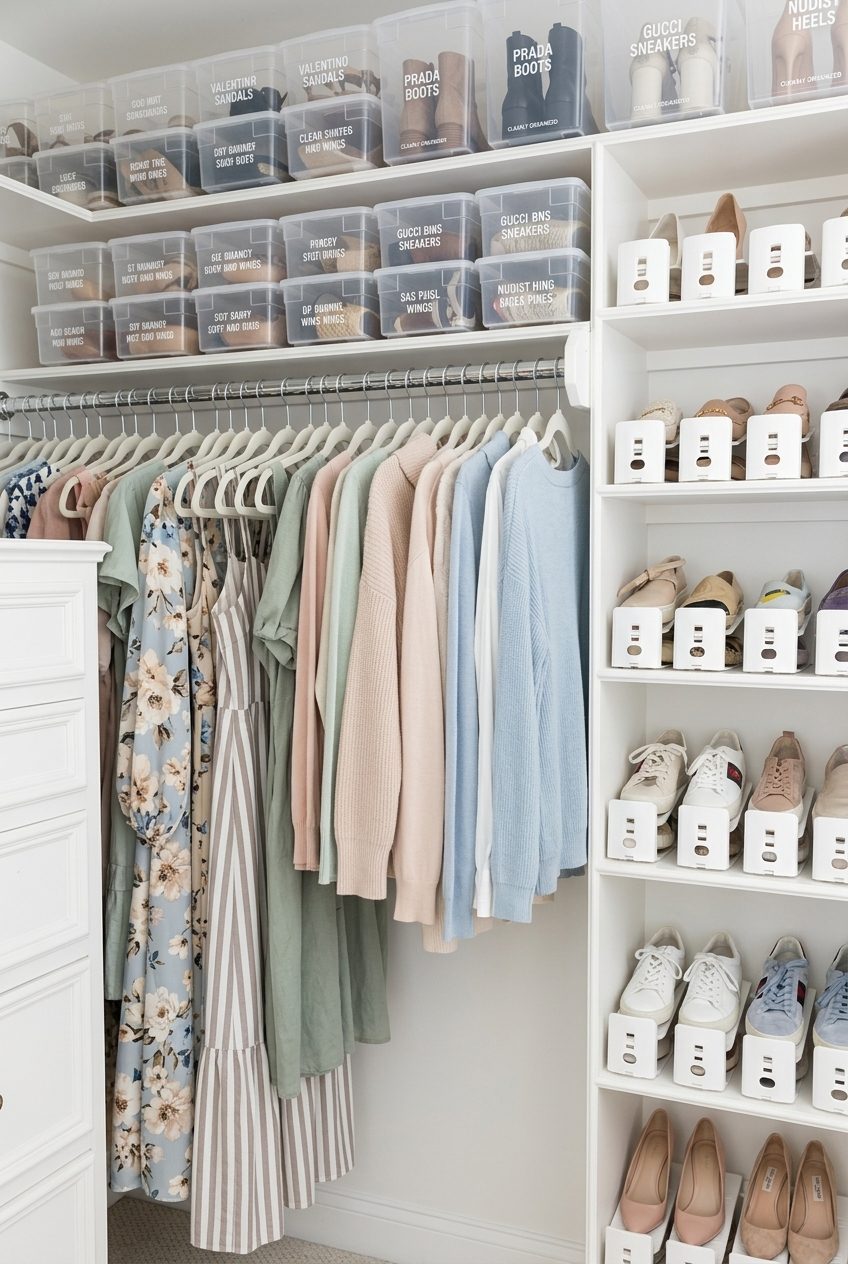
Every good closet system has zones. Eye level is for daily essentials, the things you reach for every morning. Top shelves are for seasonal items and things you only need a few times a year. Lower shelves and floor space are for heavier or bulkier items.
This is where the right products make the system work physically, not just conceptually.
Slim velvet hangers replace bulky plastic hangers and instantly free up 30 to 40 percent more rod space. The velvet grips fabric so nothing slides to the floor. If you do one thing from this entire post, switch your hangers. The difference is dramatic enough that you will think you decluttered half your wardrobe.
If one rod is not enough after the hanger swap, an adjustable second rod uses the dead air below the existing rod to double your hanging capacity. No drilling, no tools, completely renter friendly. For apartments with barely any closet space at all, a freestanding clothing rack gives you a full extra hanging section that looks stylish in the bedroom.
Shelf dividers keep folded stacks from toppling sideways, which is the number one reason neat shelves collapse into chaos within days. They clip onto existing shelves with no tools. Sweaters stay upright. Jeans stop falling into t-shirts. This is the most underrated closet organizing product because it solves a frustration most people accept as normal.
If your closet has one rod and one shelf and that is it, stackable closet shelves add adjustable vertical storage that turns a single shelf into three. This is the upgrade that makes a basic rental closet function like a custom built one.
Clear storage boxes on high shelves let you see exactly what is inside without pulling them down. Store seasonal clothes in these alongside vacuum storage bags that compress bulky items by 80 percent. Label each box so swapping takes thirty minutes, not an entire day.
An over the door organizer turns the hidden back of the closet door into prime storage space. One organizer can hold scarves, belts, hats, and accessories. Add a jewelry organizer on the wall or inside the door to keep necklaces, earrings, and rings visible and tangle free instead of buried in a box you never open.
For deeper shelves where things disappear at the back, pull out baskets slide forward so you can see and reach everything without digging. They sit on the shelf with nothing to install.
When every category has a dedicated zone and the right product holding it in place, putting things back takes zero thought. That is the entire point of a closet system: making the right choice the easy choice.
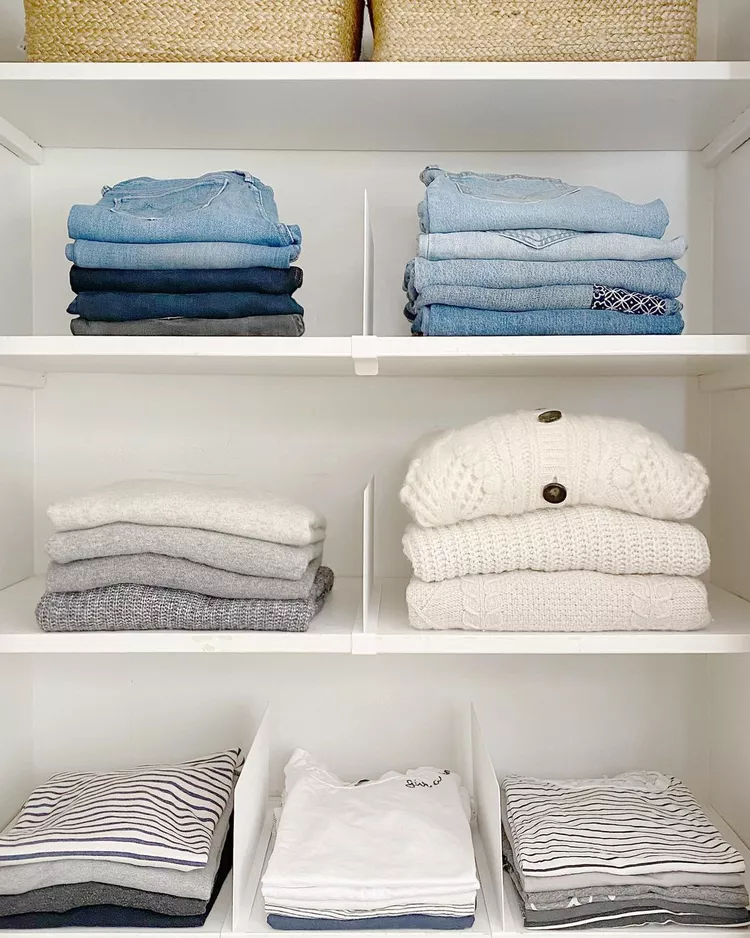
Image credit: @breathing.room.home
Step 5: The Two Minute Routine That Makes It Permanent
This is the step that separates people whose closets stay organized from people who reorganize every three months. A quick two minute reset at the end of the day: return anything out of place to its zone, straighten what shifted, close the doors. Dirty clothes go straight into a slim laundry hamper inside the closet instead of onto the bedroom chair. Done.
Without this habit, no closet organizing method in the world will last. With it, your closets maintain themselves. The system does the heavy lifting. You just keep it running.
Once a week, a ten minute scan: straighten stacks, check the floor, wipe one shelf. Toss in a few cedar blocks between your sweaters and in your shoe zone. They keep everything smelling fresh and repel moths naturally. Once a month, pull out one category, evaluate, and edit. That is a clean house schedule that keeps every closet calm permanently. Less than 15 minutes a week total.
A garment steamer hanging on the inside of the closet door means wrinkled pieces get a quick steam instead of sitting in the “I need to iron this” pile for weeks. Getting dressed becomes effortless when every item is ready to wear the moment you pull it off the hanger.

Shop Everything In This Post
Here is every product mentioned above, in one place. The five that make the biggest difference first, then the rest of the list.
The 5 That Matter Most
Drawer Organizers (Step 2)
 Shop Drawer Organizers
Label Maker (Step 3)
 Shop Label Maker
Slim Velvet Hangers (Step 4)
 Shop Slim Velvet Hangers
Over the Door Organizer (Step 4)
 Shop Over the Door Organizer
Garment Steamer (Step 5)
 Shop Garment Steamer
Everything Else Mentioned Above
One System for Every Closet in Your Home
The beauty of this closet organizing approach is that it scales. Once you learn the five steps, you apply them everywhere: bedroom wardrobe, coat closet, linen closet, bathroom cabinet, kitchen pantry, utility closet. Same framework, adapted to the purpose of each space.
Most people start with the closet that causes them the most daily stress, usually the bedroom. Once that one feels calm, the motivation to tackle the next closet comes naturally. You do not need to do your whole home in a weekend. One closet at a time, fifteen minutes a day.
Store seasonal items you rotate in under bed storage bins to free up closet space for what you actually wear right now. When swap day comes, pull the bin out, switch the contents, slide it back. Thirty minutes and your closet is refreshed for the new season.

For specific product recommendations for each room, these guides break it down further:
- Small bedroom closet ideas for the wardrobe that causes the morning stress
- 15 small closet organization ideas for maximizing every inch
- 13 bathroom organization products for the cabinet under the sink
- Small pantry organization for the kitchen closet
- Shoe storage ideas for the pile by the door
Home Organization Starts Behind Closed Doors
When people think about home organization, they picture the kitchen counter or the living room shelves. The visible spaces. But the closets are where clutter actually lives. When your closets are chaotic, the mess leaks into the rest of your home. You buy duplicates because you cannot find things. Mornings feel rushed because getting dressed is a battle. Guests see a tidy room but you know the closet behind you is barely holding together.
Fix the closets first and everything else follows. You spend less, waste less time, and your home feels lighter even though nothing visible changed. That is the power of a real closet system working behind the scenes.
If you want to take it further and reset your entire home, not just the closets, my 30 day home organization reset uses the same five step method room by room across your entire apartment.

Image credit: Urban Organyze
A calm closet is not about owning less. It is about keeping only what earns its place and having a system that keeps it there.
More closet and organizing guides:
- Small Bedroom Closet Ideas
- Why Your Closet Keeps Getting Messy
- 15 Small Closet Organization Ideas
- 19 Renter Friendly Closet Ideas
- 30 Day Home Organization Reset
- Shoe Storage Ideas for Small Spaces
STOP PINNING. START ORGANIZING.
The Calm Closet Workbook
6 ready to use closet worksheets, one for every closet type.
Capsule wardrobe planner and seasonal rotation tracker.
21 day challenge that makes the habit automatic.
45 printable pages · Instant download · Works digitally or printed
Get The Calm Closet · $6.99Join hundreds of women who turned their cluttered closets into calm spaces
Prices listed were accurate at the time of writing and may change. Always check the current price on the product page before buying.
This post contains affiliate links. If you make a purchase through these links, I may earn a small commission at no extra cost to you. I only recommend products I actually use and love.
Leave a Reply